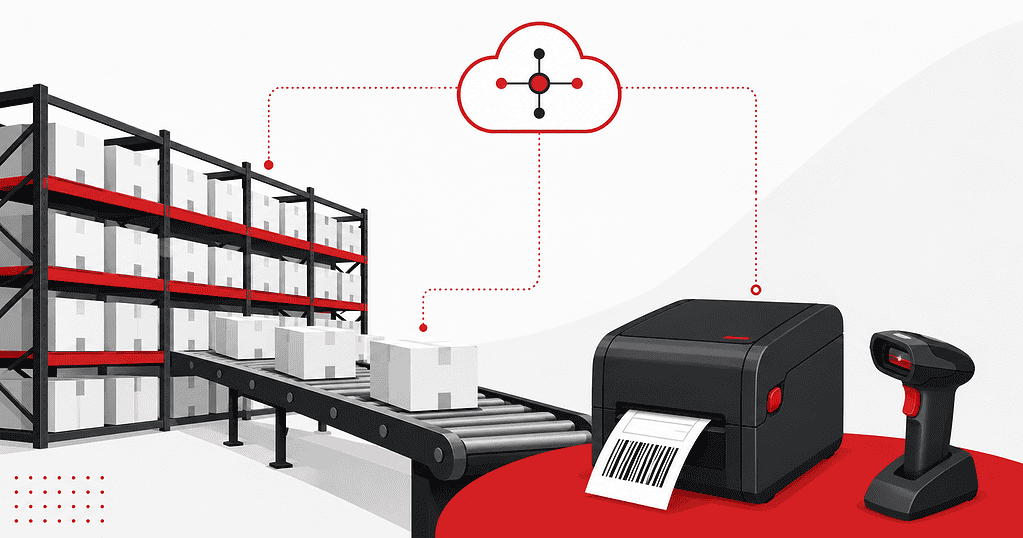
Two months inside a live ERP rollout: warehouse printing across every printer type, team training, and a production fix, all delivered remotely.
The short version:
- Client: A large vehicle parts distributor (anonymized) shipping to hundreds of dealerships, with tens of thousands of SKUs
- Context: Fresh off a merger, mid-migration from a legacy ERP to NetSuite with WMS and SuiteScript customizations
- My role: Consultant on the implementation: printing integration across the warehouse, team training, production debugging
- Engagement: Two months, fully remote
A merger, then an ERP
The sequence here is one PE readers will recognize, because it’s the standard playbook. The distributor merged, got bigger, and the legacy ERP that ran the old company couldn’t carry the combined one. Post merger integration almost always lands on the systems eventually, and for product businesses at this scale it usually lands on NetSuite.
By the time I was brought in as a consultant, the NetSuite implementation was underway: warehouse management, SuiteScript customizations, the works. Tens of thousands of SKUs moving through a warehouse and out to hundreds of dealerships, and all of it had to keep shipping while the systems changed underneath it.
Where I came in
My piece of the rollout was the part that connects software to the physical warehouse: making NetSuite talk to the printers, then making the people comfortable with both.
That sounds small until you watch a warehouse try to operate without it. Every pick, pack, and shipment at this scale runs on printed labels and scannable codes. If the ERP can’t reliably push a label to the right printer on the floor, the fancy new WMS is a very expensive way to stop shipping parts.
The printer problem
The integration ran through a desktop plugin bridging NetSuite to the printer fleet, and the fleet was mixed: standard office printers alongside Zebra thermal label printers. Anyone who has done Zebra printer setup at scale knows the deal. Thermal printers are workhorses right up until they’re not, and their failure modes are finicky: driver quirks, connection drops, labels that render fine on one model and misalign on the next.
I configured the plugin across the printer types, sorted out the per-model quirks, and got label output consistent from the warehouse floor’s point of view: scan, print, move on. The scanning workflow only works when the label side holds up, so that consistency was the whole job.
Training, then a production fire drill
Configuration is half of an implementation. The other half is the team actually using it without calling for help every hour, so I trained the staff on the new printing workflow as part of the engagement.
Then, after go-live, a connection issue surfaced between the printers and the system in production. This is the moment that separates a rollout that sticks from one that breeds workarounds: the warehouse is live, orders are flowing, and something between the ERP and the printer fleet is dropping. I debugged it remotely with my own remote tooling, traced the connection fault, and got it resolved without a site visit.
The whole engagement ran that way. Two months, entirely remote, from configuration through training through the production fix. Distance never cost the client anything, which matters if your operation isn’t down the street from your consultant.
The result
At the end of two months the distributor had warehouse printing running reliably across a mixed fleet inside NetSuite, a trained team running the workflow themselves, and a production issue diagnosed and closed. My workstream wrapped clean, and the operation kept shipping to its dealerships through all of it.
Why this one matters if you’re a buyer
The first two case studies on this site are about security and migrations. This one is here to make a different point: I work deep in the systems businesses actually run on, including one of the largest ERPs on the market.
When a PE firm buys a distributor, the value creation plan almost always touches the ERP, the warehouse workflow, or both. That work fails at the unglamorous layer: the label that won’t print, the scanner workflow nobody trained the floor on, the customization nobody documented. I’ve done that layer, at real scale, on NetSuite, and the same goes for the CRMs and finance systems on the other side of the stack.
If your deal thesis depends on systems doing what the model says they’ll do, that’s the work I do.
Have a rollout or an integration that needs to land? Get in touch.